

This post looks at what dates add to a pregnancy diet: the nutrients in them, what studies found about eating dates in the last weeks before labour, and simple ways to eat them.
This is general information, not medical advice. Talk to your doctor or midwife before changing your diet in pregnancy, especially if you have diabetes or gestational diabetes.
Nutrients in dates
Here are some key nutrients found in dates. Amounts are per 100 g of Medjool dates from USDA FoodData Central; what each nutrient does is from the NHS (potassium and magnesium, vitamin B6, iron in pregnancy, fibre in pregnancy).
| Nutrient | Amount and what it does |
|---|---|
| Fiber | 6.7 g. Helps digestion and can help prevent constipation. |
| Potassium | 696 mg. Helps control the balance of fluids in the body and helps the heart muscle work properly. |
| Iron | 0.9 mg, a small amount. You need iron to make red blood cells for you and your baby. |
| Vitamin B6 | 0.25 mg. Helps the body use and store energy from protein and carbohydrates, and helps form haemoglobin. |
| Magnesium | 54 mg. Helps turn food into energy and helps the parathyroid glands, which make hormones important for bone health, work normally. |
What dates add to a pregnancy diet
1. Energy
Dates are energy-dense. USDA lists 277 kcal and 75 g of carbohydrate per 100 g of Medjool, so one pitted date (24 g) gives about 66 kcal (USDA). That makes them a quick snack between meals. Tiredness in pregnancy can also come from low iron, which your midwife checks with routine blood tests at booking and around 28 weeks (NHS). Dates do not replace that check.
2. Fibre and constipation
The NHS says constipation is common during pregnancy and after giving birth. Its advice is to drink plenty of fluids and increase the fibre in your diet gradually, and it says these steps are safe to try when you are pregnant (NHS). One pitted Medjool date has about 1.6 g of fibre. Adults are advised to aim for 30 g of fibre a day from a mix of foods (NHS).
3. Nutrients for you and your baby:
We found no study showing that eating dates changes how a baby grows. Dates add small amounts of nutrients that matter in pregnancy. Iron is the clearest example: you need it to make red blood cells for you and your baby, but dates carry little of it, so they cannot stand in for the iron supplements a doctor or midwife may recommend. The NHS also advises a folic acid supplement, 400 micrograms a day for the first 12 weeks, because it is difficult to get enough from food alone (NHS).
4. Antioxidants
Dates contain phenolic acids and carotenoids, and the amounts vary with the variety and how ripe the fruit is (Tang et al., 2013). Most research on these compounds in dates has been done in the lab and on animals, and a 2012 review called studies of the health benefits of dates in people inadequate (Vayalil, 2012). We found no study showing that dates improve immunity in pregnancy.
What studies found about dates before labour
In a study in Jordan, 69 women ate six dates a day for the four weeks before their due date and 45 women ate none. The date group arrived at hospital with a wider cervix (3.52 cm against 2.02 cm), more went into labour on their own (96% against 79%), and fewer needed drugs to start or speed up labour (28% against 47%). It was a prospective study, not a randomised trial, and the authors said a randomised trial was needed (Al-Kuran et al., 2011).
A 2024 review pooled 48 studies. Eating dates late in pregnancy was linked with shorter labour and less need for induction, but the authors rated the overall quality of the evidence as unacceptable, with a high risk of bias in most studies, and safety was recorded in only four trials (Salajegheh et al., 2024). So the results are a reason to ask your midwife, not a plan to follow on your own.
Dates are also high in sugar. Gestational diabetes is high blood sugar that develops during pregnancy, and it usually causes no symptoms, so it is found through screening (NHS). If you have it, ask your diabetes team how many dates fit your meal plan.
Ways to eat dates in pregnancy
1. As a snack
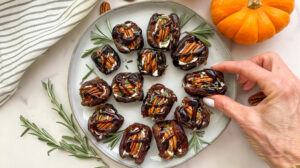
Two or three dates make a sweet snack between meals. One pitted Medjool is about 66 kcal, so count them if you are watching your sugar.
2. In smoothies
Blend dates into your favorite pregnancy smoothies for natural sweetness. Once fruit is blended, the NHS counts its sugars as free sugars and suggests keeping smoothies to 150 ml a day (NHS).
3. In baking
Dates can be used as a natural sweetener in baked goods like muffins, energy bars, and lactation cookies. Dates can replace some of the refined sugar, though date paste still counts as free sugar. Our post on dates as a sugar swap covers this in more detail.
Conclusion
Dates are a handy source of fibre, potassium and quick energy in a pregnancy diet, and their fibre can help with the constipation many women get in pregnancy. The studies on eating dates before labour are encouraging but low in quality. For more on potassium, see dates and blood pressure, and to choose a variety, see Ajwa dates: taste and where to buy. For prices and orders, contact us.
References
- Al-Kuran O et al. The effect of late pregnancy consumption of date fruit on labour and delivery. J Obstet Gynaecol. 2011;31(1):29-31. PubMed 21280989
- Salajegheh Z et al. Is oral consumption of dates in the peripartum period effective and safe integrative care to facilitate childbirth and improve perinatal outcomes: a revised systematic review and dose-response meta-analysis. BMC Pregnancy Childbirth. 2024;24(1):12. PubMed 38166785
- Tang ZX, Shi LE, Aleid SM. Date fruit: chemical composition, nutritional and medicinal values, products. J Sci Food Agric. 2013;93(10):2351-61. PubMed 23553505
- Vayalil PK. Date fruits (Phoenix dactylifera Linn): an emerging medicinal food. Crit Rev Food Sci Nutr. 2012;52(3):249-71. PubMed 22214443
- USDA FoodData Central. Dates, medjool (FDC 168191). fdc.nal.usda.gov
- NHS. Have a healthy diet in pregnancy; Pregnancy vitamins and supplements; Gestational diabetes. nhs.uk, nhs.uk, nhs.uk
- NHS. Constipation; How to get more fibre into your diet; Sugar: the facts. nhs.uk, nhs.uk, nhs.uk
- NHS. Vitamins and minerals: others; Vitamin B. nhs.uk, nhs.uk