

Ask any Pemborong kurma which dates sell best and you will hear Tunisian Deglet Noor and Medjool, and you will often hear them called a heart-friendly food. This article looks at what the research says about dates, potassium and blood pressure, and where the usual claims go further than the evidence.
Dates contain potassium, magnesium, fiber and plant compounds called polyphenols. Whether you enjoy kurma Tunisia for its firmer, chewy bite or kurma Medjool for its rich, caramel-like sweetness, dates can be part of a heart-friendly diet alongside plenty of vegetables and other fruit.
This article is general information, not medical advice. If you have high blood pressure or kidney disease, or take blood pressure medicine, talk to your doctor before changing your diet, and keep taking any medicine you have been prescribed.
Dates and heart health
Dates have been eaten for centuries, and traditional medicine has long credited them with health benefits. The research has only partly caught up. A 2025 review of dates and hypertension found that clinical studies report lower blood pressure with regular, moderate date eating, but it also says standardised human trials are limited and larger randomised trials are needed (Jim et al., 2025).

High blood pressure, also known as hypertension, usually has no symptoms, and the only way to know you have it is to get it checked. Left untreated, it can lead to heart disease, stroke and kidney disease (WHO). Dates will not manage it on their own. At most they are one small part of the diet changes doctors recommend.
Why blood pressure matters
Blood pressure is the force exerted by circulating blood against the walls of the arteries. When this pressure is consistently high, it damages the arteries and strains the heart. Diet plays a part: WHO counts too much salt and too few fruits and vegetables among the risk factors you can change.
What is in a date
Per 100 g, Medjool dates have 696 mg of potassium, 54 mg of magnesium and 6.7 g of fiber. Deglet Noor, the main Tunisian variety, has 656 mg of potassium, 43 mg of magnesium and 8 g of fiber (USDA FoodData Central: Medjool, Deglet Noor). Potassium is the nutrient with the strongest link to blood pressure. Fiber counts too. The NHS says eating plenty of fibre is associated with a lower risk of heart disease and stroke, and most adults manage about 20 g a day against a 30 g target (NHS).
Dates also contain polyphenols and flavonoids. Reviews describe these compounds lowering oxidative stress and inflammation, but the human trials behind that are still limited (Jim et al., 2025).
Key nutrients in dates

In short, potassium has the best evidence for blood pressure and fiber is linked to lower heart disease risk. The magnesium and antioxidant claims are weaker, for the reasons below.
Potassium, magnesium and blood pressure
The best evidence is for potassium. A WHO-led review of 22 randomised trials found that eating more potassium lowered systolic blood pressure by about 3.5 mmHg and diastolic by about 2 mmHg in adults with hypertension, with no clear effect in people without it. Higher potassium intake was also linked to a 24% lower risk of stroke (Aburto et al., 2013). That research is about total potassium in the diet, and dates are one source of it. The same review says the benefit applies to people whose kidneys handle potassium normally, so anyone with kidney disease should ask their doctor first.
Magnesium has a smaller effect. In a meta-analysis of 34 trials, magnesium supplements at a median 368 mg a day lowered blood pressure by about 2 mmHg systolic and 1.8 mmHg diastolic (Zhang et al., 2016). A 100 g serving of Medjool gives 54 mg, so dates add a little magnesium, nowhere near a supplement dose.
Fiber and heart health
The fiber in dates helps you get closer to the 30 g a day target. Being overweight raises the risk of high blood pressure, and WHO advises losing weight if you are overweight (WHO). Dates are also high in calories, 277 kcal per 100 g of Medjool, so they help most as a swap for sweets, not as an extra on top.
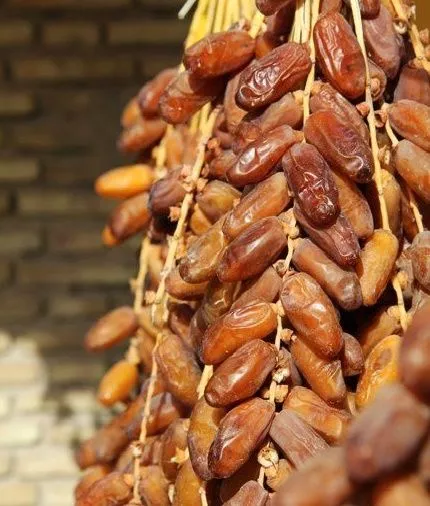
Kurma Tunisia (Deglet Noor)
Most kurma Tunisia is Deglet Noor, a semi-dry date that is firmer, chewier and less sticky than Medjool. It has 656 mg of potassium per 100 g, close to Medjool. It is a good everyday date, though the blood pressure research is about potassium-rich diets, not this variety in particular.
Like other dates, kurma Tunisia contains polyphenols and 8 g of fiber per 100 g.
Kurma Tunisia in your daily diet
Adding kurma Tunisia to breakfast cereals, smoothies, or salads is a simple way to add fiber and potassium while enjoying its subtle sweetness.
Kurma Medjool
Kurma Medjool is a large, soft date with a caramel-like flavour. Each 100 g, about four dates, has 696 mg of potassium and 54 mg of magnesium.

Kurma Medjool has 6.7 g of fiber per 100 g, which helps digestion and your daily fibre total.
Kurma Medjool as a snack
Kurma Medjool can be enjoyed on its own or stuffed with nuts for a filling snack. Keep portions small: four Medjool dates (about 96 g) carry roughly 265 kcal.
Ways to eat dates
You can eat dates as a snack, add them to smoothies, or use them as a natural sweetener in desserts. For those who prefer savory dishes, dates can be incorporated into salads or paired with cheese for a balanced flavor profile.
Using dates in place of sweets or refined sugar is the easiest way to make them a regular food; this guide to dates as a natural sweetener has ideas.
Recipes with dates
From energy balls to stuffed dates, there are countless ways to enjoy dates. If you buy in bulk for a shop or a big family, see this buyer's guide to wholesale date prices.
Lifestyle and heart health
Diet is one piece of blood pressure control. WHO's advice puts eating more vegetables and fruit next to at least 150 minutes a week of moderate exercise, less salt, less alcohol, no tobacco and losing weight if needed, and it notes that many people will still need medicine (WHO). Dates belong to the fruit part of that list.
Treat dates as one part of a balanced diet, not a remedy.
Dates and exercise
Eating a few dates before or after a workout gives quick energy from their natural sugars.

What the evidence on dates and blood pressure shows
The strongest evidence is indirect. Trials show that more potassium lowers blood pressure in people with hypertension (Aburto et al., 2013), and dates are a good source of potassium. That is not the same as proof that dates treat hypertension.
Studies of date compounds describe antioxidant and anti-inflammatory effects, but human trials are still too few to say how much that matters for the heart.
Research findings
A 2025 review reports that clinical studies of regular, moderate date eating have shown lower systolic and diastolic blood pressure without harming blood sugar. The authors also note that date varieties and ripeness differ between studies, and that larger randomised trials are needed before anyone can set a dose (Jim et al., 2025).
Conclusion
Dates are a potassium- and fiber-rich fruit that fits well in a heart-friendly diet. The evidence linking potassium to lower blood pressure is strong. The evidence for dates themselves is promising but still thin. Kurma Tunisia and kurma Medjool both fit; Medjool is softer and more calorie-dense per date.
Eat them in place of sweets, keep portions sensible, and treat them as a complement to exercise, less salt and any medicine your doctor recommends.
References
- World Health Organization. Hypertension fact sheet.
- NHS. How to get more fibre into your diet.
- USDA FoodData Central. Dates, medjool (FDC 168191); Dates, deglet noor (FDC 171726).
- Aburto NJ, et al. Effect of increased potassium intake on cardiovascular risk factors and disease: systematic review and meta-analyses. BMJ. 2013;346:f1378. PMID 23558164.
- Zhang X, et al. Effects of magnesium supplementation on blood pressure: a meta-analysis of randomized double-blind placebo-controlled trials. Hypertension. 2016;68(2):324-33. PMID 27402922.
- Jim EL, et al. Nature's cardioprotective sweetness: a review of dates as functional food in hypertension. Foods. 2025;14(24):4208. PMID 41464915.